 Guided tour
Season: Year-round
Iwakuni and Kintaikyo Bridge tour
- Cross the five wooden arches of Kintaikyo
- Ride the ropeway up to Iwakuni Castle

Bridge
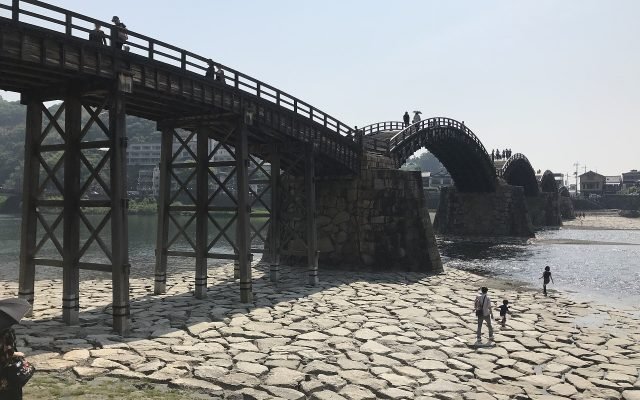
Kintaikyo is one of the most famous bridges in Japan. Its five wooden arches leap across the wide, shallow Nishiki River in Iwakuni, in the far east of the prefecture. The first bridge of this design was built in 1673 by the local lord, and it has been carefully rebuilt, using traditional joinery, ever since.
The Nishiki River floods violently after heavy rain, and earlier bridges here were washed away again and again. In 1673, Kikkawa Hiroyoshi, the third lord of Iwakuni, built a bridge with no piers in the middle of the arches, resting on four massive stone piers instead, and it survived for more than 270 years until a typhoon swept it away in 1950. It was rebuilt in 1953, and replaced again, piece by piece, between 2001 and 2004. Walking up and down over its steep wooden arches is a pleasure in any season.

Buses run to the bridge from Iwakuni Station, about 20 minutes, and Shin-Iwakuni Station on the shinkansen, about 15 minutes. Iwakuni Station is under an hour from Hiroshima by local train. Read our guide to visiting Kintaikyo and Iwakuni.
Book ahead
Guided tour
Season: Year-round Guided tour
Season: Year-round
 Walking tour
Season: Year-round
Nearby
 Castle town
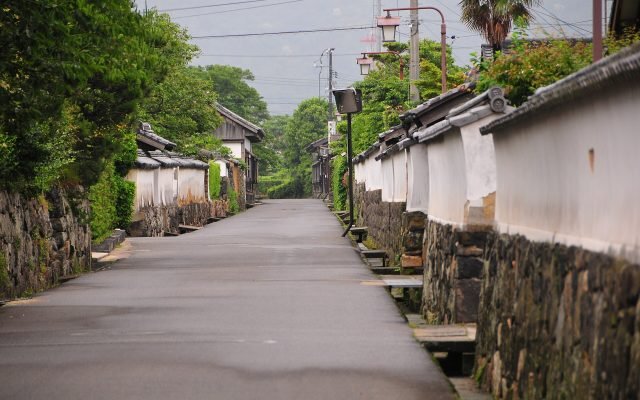
Samurai lanes and Hagi ware
The old castle town of the Mori lords on the Sea of Japan, with samurai houses, earthen walls, the school of Yoshida Shoin and the famous Hagi ware pottery.
 Karst & cave
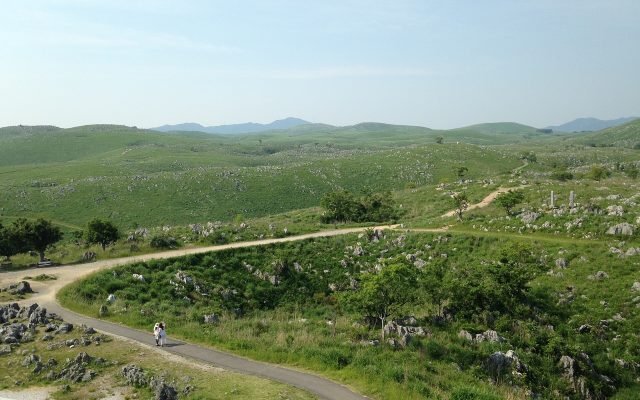
A stone-studded plateau and a giant cave
Japan’s largest karst plateau, a rolling grassland dotted with white limestone pillars, above Akiyoshido, one of the biggest limestone caves in the country.
 City
Fugu, a fish market and the strait
The port city at the western tip of Honshu, famous for fugu, Karato fish market and its sushi stalls, Akama Shrine and the walk under the sea to Kyushu.